If your weekday starts with checking train times, watching ferry schedules, or calculating how many blocks stand between your front door and Midtown, Long Island City deserves a close look. For many buyers, the goal is not just finding a beautiful condo. It is finding one that makes daily life easier, more predictable, and less stressful. In this guide, you will learn how to choose the right Long Island City micro-location, what commute-friendly condo features matter most, and how to think about value before you buy. Let’s dive in.
Why Long Island City Appeals to Commuters
Long Island City stands out because it offers an unusual amount of transit access in one Queens neighborhood. Long Island City Partnership describes LIC as the neighborhood’s fourth central business district and notes that it is served by 8 subway lines, 15 bus lines, 3 ferry landings, 2 Long Island Rail Road stations, and 74 Citi Bike stations. It also describes LIC as a single subway stop from Midtown Manhattan and Brooklyn.
That kind of network gives you options when your routine changes. If one train line is delayed or your office location shifts, having multiple nearby transit choices can make a real difference. For many buyers, that flexibility is just as valuable as square footage or amenities.
It also helps to know that LIC is not one uniform commute market. NYC Planning divides the Special Long Island City Mixed Use District into four subdistricts: Queens Plaza, Court Square, Hunters Point, and Dutch Kills. Most new office and residential development is concentrated in Queens Plaza and Court Square, where about 10,100 housing units, more than 1.5 million square feet of office space, and 600 hotel rooms have been developed or are in the pipeline.
Pick the Micro-Location First
In Long Island City, your exact location can shape your daily routine more than the condo itself. Two homes may both have a LIC address, but one may place you near overlapping train options while the other adds extra walking time every morning. That is why commute-first buyers usually benefit from choosing the transit node first and the building second.
Hunters Point for 7 Train and Ferry Access
Hunters Point is a strong fit if you want easy access to the 7 train and the NYC Ferry. The MTA’s 7 line includes Hunters Point Av and Vernon Blvd-Jackson Av, and the NYC Ferry East River route serves Hunters Point South with service continuing to East 34th Street and Wall Street/Pier 11. Long Island City Partnership also notes ferry stops at Hunters Point South and Gantry Plaza State Park, with connections to Manhattan, Brooklyn, Roosevelt Island, and Astoria.
For many buyers, this area offers a simple commute setup with a waterfront setting. That combination often supports premium pricing. Current market snapshots show 66 condos for sale in Hunters Point at a median listing price of $1.1 million, while the broader Hunters Point market posted a median home sale price of $1.175 million in March 2026.
Court Square for Transit Redundancy
If you want the broadest set of rail options, Court Square is often the most practical choice. The MTA maps show the LIC segment of the 7 line including Queensboro Plaza, Court Sq, Hunters Point Av, and Vernon Blvd-Jackson Av. The E route includes Queens Plaza and Court Sq-23 St, the M also includes Queens Plaza and Court Sq-23 St, and the G line terminates at Court Sq with transfers to E and M service.
This is part of why Court Square is widely seen as the strongest all-around transit hub in LIC. NYC Planning also identifies Queens Plaza and Court Square as the areas holding much of LIC’s newer office and residential stock. If your priority is a short path to multiple Midtown-bound options, this area deserves serious attention.
Queens Plaza for Fast Access and Newer Stock
Queens Plaza and nearby Queensboro Plaza form another major commuter node. The MTA’s 7 line map shows Queensboro Plaza with N and W weekday service, and the station is ADA accessible. The MTA also completed two new elevators there in 2024, while the accessible stations list includes both Queens Plaza and Queensboro Plaza.
This area often appeals to buyers who want multiple subway options and a large supply of newer condos. The trade-off is that the setting feels more infrastructure-focused than waterfront-oriented. If your top priority is speed and connectivity, that may be a trade worth making.
Dutch Kills Requires More Block-by-Block Review
Dutch Kills is part of the same mixed-use district, but it has a more varied urban fabric. NYC Planning describes the district as a mix of residential, commercial, and light industrial uses. It also notes that Northern Boulevard is a heavily trafficked corridor with loft buildings on one side and auto-related uses on the other.
That does not make Dutch Kills a poor option. It simply means you should review each address carefully. In this part of LIC, the real question is how long your actual walk will be to Queens Plaza, Court Square, or the 7 line.
Commute Features That Matter Most
When you are shopping for a condo, it is easy to get pulled toward finishes, views, or flashy amenities. Those can matter, but if your main goal is an easier workweek, the everyday practical features often have more value. The best condo for a commuter is usually the one that saves you time and friction.
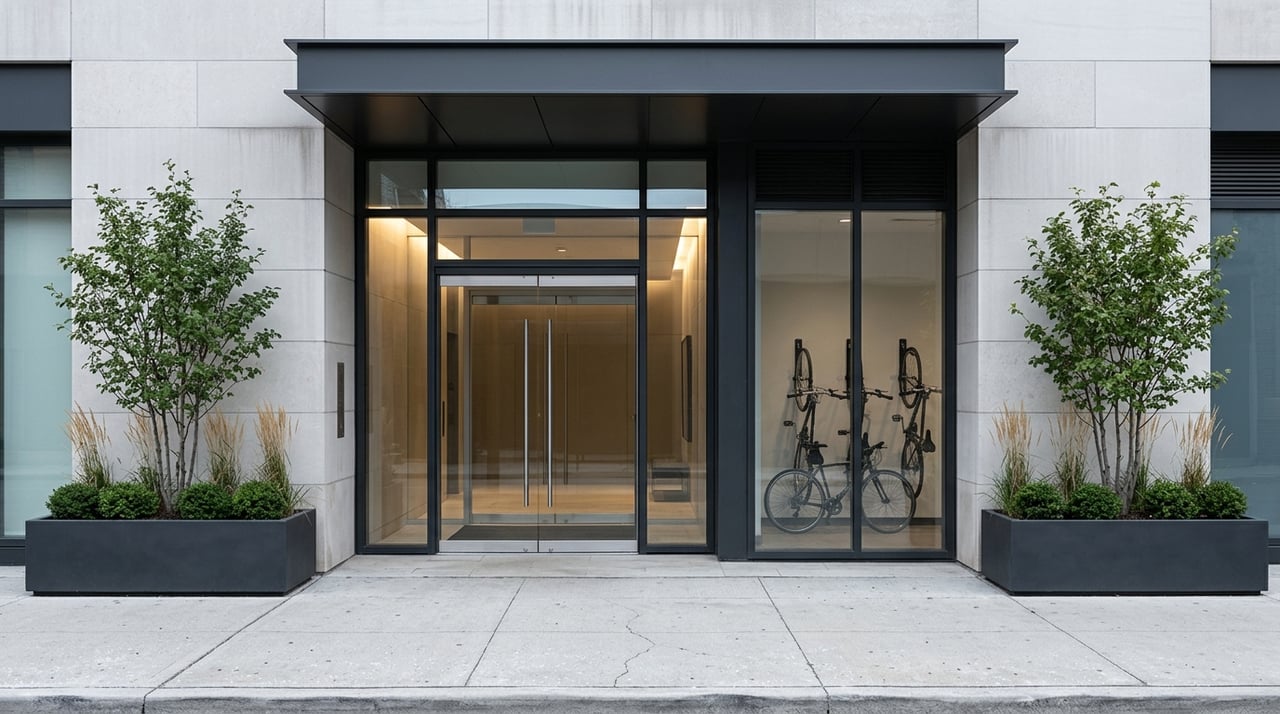
Representative newer LIC condo buildings commonly include amenities such as full-time doorman or concierge service, package rooms, fitness centers, resident lounges, roof decks or terraces, bike storage, storage units, and sometimes parking. Examples in the market include buildings with staffed lobbies, package handling, on-site laundry, bike rooms, and fitness spaces.
For a commute-first buyer, these are usually the most useful features:
- Staffed lobby or concierge: Helpful for secure deliveries and smoother weekday logistics.
- Package room: Important if you rely on deliveries and do not want missed drop-offs.
- Bike storage: A real time-saver if you bike to transit or around the neighborhood.
- On-site laundry: Convenient during busy workweeks.
- Storage space: Useful if you want to keep your living area less cluttered.
- Parking: Valuable only if you truly need it for your routine.
Luxury extras like pools, saunas, business centers, and pet-focused amenities may still help with future appeal. Still, the strongest long-term value in LIC usually starts with the building’s location and transit access.
Accessibility and LIRR Options
Subway access gets most of the attention in LIC, but it is not the only option. The neighborhood also has Long Island Rail Road service. The MTA lists the Long Island City station as accessible and notes connections to Vernon Blvd-Jackson Av, the Q103, and NYC Ferry. Long Island City Partnership places that station at Borden Avenue and 2nd Street.
There is also Hunterspoint Avenue station, but the MTA notes that it is not accessible. The nearest accessible LIRR stations are Long Island City and Woodside. If accessibility is part of your home search, this is the kind of detail to confirm early.
The same goes for subway stations. Queens Plaza and Queensboro Plaza are listed as accessible, and Queensboro Plaza received two new elevators in 2024. If you want a smoother daily route, station accessibility can be just as important as travel time.
How to Think About Price and Resale
Long Island City’s condo market gives buyers choices, but it also shows a clear commute premium in the most convenient areas. Current market snapshots show 132 condos for sale in Long Island City at a median listing price of $765,000 and a median time on market of 60 days. Another market snapshot places Long Island City at a median listing price of $949,750, a median 57 days on market, and a 97% sale-to-list ratio, while describing the neighborhood as a buyer’s market as of March 2026.
Inside LIC, location still matters a great deal. Hunters Point, with its 7 train and ferry access, shows a higher pricing profile than the broader neighborhood. That suggests many buyers are willing to pay more for a stronger commute story.
There is also evidence that new development continues to influence pricing. A LIC and Astoria market report for the second half of 2025 found that the combined market’s median price fell 5% year over year to $1.071 million, but average and median price per square foot hit record levels as new development and park-front closings supported pricing. The same report said new development posted 102 closings, up 73% year over year.
For you as a buyer, the takeaway is straightforward. A condo that sits a few minutes closer to Court Square, Queens Plaza, the 7 train, or the ferry may have a wider future buyer pool than one with similar finishes but a weaker location. In a neighborhood shaped by commuting patterns, that can matter at resale.
A Simple Buying Strategy for LIC
If you want to buy smart in Long Island City, keep your process focused. Start with your real routine, not a generic idea of convenience. The right condo is the one that fits how you move through the city every day.
A practical approach looks like this:
- Choose your main commute mode first. Decide whether you will rely most on the 7 train, E or M service, the ferry, LIRR, or a mix.
- Map the daily walk. Count the blocks from the building to the station or ferry landing you would actually use.
- Check backup options. The best LIC locations often offer more than one useful route.
- Review building logistics. Look at package handling, bike storage, laundry, and lobby staffing.
- Compare price against convenience. A slightly higher price may be worth it if it improves your routine every day.
- Think ahead to resale. Another buyer may value the same short walk and transit flexibility later.
In many cases, the smartest buy is not the condo with the longest amenity list. It is the one that combines a reliable commute, practical building features, and a location that stays appealing over time.
If you are weighing condo options in Long Island City, a local, block-by-block view can save you time and help you avoid overpaying for the wrong kind of convenience. For tailored guidance on LIC micro-locations, commute-focused condo searches, and next steps as a buyer, connect with Elaine Tian.
FAQs
What is the best part of Long Island City for a Manhattan commute?
- Court Square is often the strongest all-around choice because it offers overlapping subway options, while Hunters Point is especially attractive if you want the 7 train and ferry access.
Is Hunters Point more expensive than other parts of LIC?
- Current market snapshots show Hunters Point with a higher median listing price than the broader Long Island City condo market, which suggests buyers place a premium on its location and commute options.
Are all Long Island City condos equally convenient for commuting?
- No. LIC includes several subareas, and your actual walk to a station or ferry landing can vary a lot from one address to another.
Which Long Island City stations are accessible?
- The MTA lists Queens Plaza, Queensboro Plaza, and the Long Island City LIRR station as accessible, while Hunterspoint Avenue LIRR station is not accessible.
What condo amenities matter most for commuters in Long Island City?
- The most practical amenities are usually a staffed lobby, package room, bike storage, on-site laundry, and other features that make weekday routines easier.
Should you choose the building first or the location first in LIC?
- For most commute-first buyers, it makes more sense to choose the micro-location and transit access first, then compare buildings within that area.